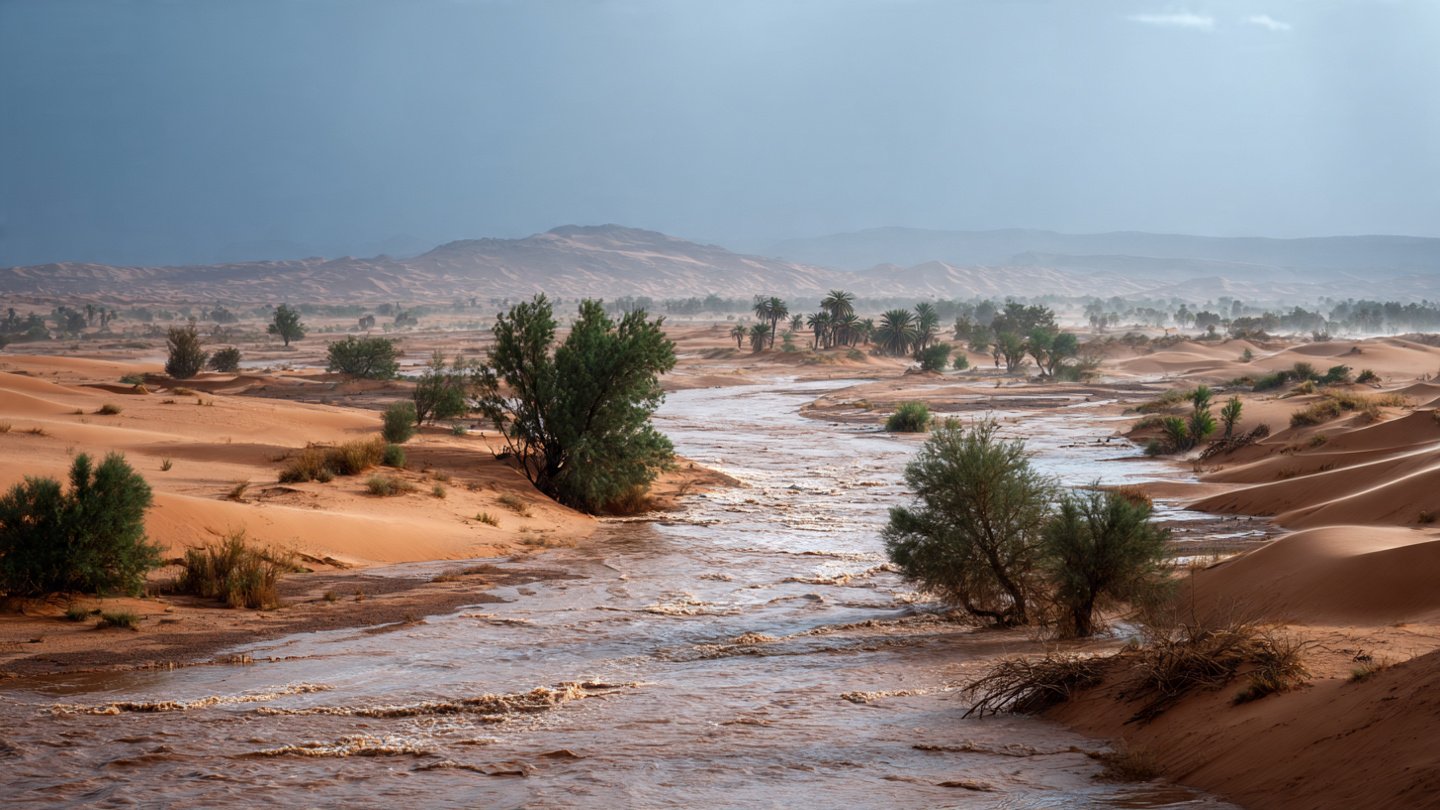
For millennia, the Sahara Desert has symbolized Earth’s most extreme dryness — a sky‑high heat, near‑absence of rain, and endless stretches of sand. But recent scientific research suggests that this desert may not remain so static. Instead, climate change could drive a dramatic increase in rainfall, potentially altering the Sahara’s landscape, reshaping ecosystems, and disrupting the delicate environmental and social balance across Africa.
Far from being a distant hypothetical, this possibility emerges from detailed climate models and paleoclimate records; scientists warn that such changes could have profound consequences for both human societies and natural systems. Understanding these shifts — and preparing for them — is crucial if African nations and global communities want to adapt effectively.
A Future Where the Sahara Becomes Wetter
A groundbreaking study led by researchers at the University of Illinois Chicago (UIC) points to the possibility that the Sahara could receive up to 75‑percent more rainfall by the end of the 21st century compared with historical averages. This dramatic change would be driven by global warming, which increases the atmosphere’s capacity to hold moisture, and by shifts in atmospheric circulation that pull more rain‑bearing air into northern Africa.
Historically, the Sahara wasn’t always the hyperarid expanse we know today. During the African Humid Period — roughly between 14,000 and 5,000 years ago — large parts of the Sahara featured grasslands, lakes, and river systems, with ecosystems very different from the modern desert. But that shift back to dryness happened over thousands of years. Now, climate models suggest that if rainfall increases as projected, portions of the Sahara could begin to green again within just decades to centuries, representing a much faster transformation than in the past.
Why More Rain Isn’t Simple Good News
At first glance, more rain in one of the globe’s driest regions might seem like an environmental benefit — especially in a continent often plagued by water scarcity. But scientists caution that excess rainfall could trigger a cascade of unintended consequences, affecting climates, ecosystems, and societies far outside northern Africa’s sandy borders.
1. Altered Weather and Monsoon Patterns
The Sahara plays a crucial role in African climate systems. Its huge heat‑absorbing surface helps drive monsoonal circulation that determines rainfall patterns across the continent. If the Sahara becomes wetter and greener, these atmospheric dynamics could shift in unpredictable ways.
For example, a greener Sahara could change the strength and northward extent of the West African Monsoon, potentially bringing heavier rains further into typically dry areas like the Sahel. But this doesn’t guarantee more steady, life‑sustaining rainfall — rather, it may produce sudden, intense downpours and flash‑flood events, threatening communities that have no infrastructure to manage such deluges.
2. Soil, Erosion, and Land Degradation
Many parts of the Sahara and the adjoining Sahel have hard, compacted soils with minimal organic matter or vegetative cover. These soils are ill‑equipped to absorb heavy rain; instead, the water runs off quickly, causing erosion, washing away topsoil, and degrading landscapes.
Topsoil is a foundation for agriculture — without it, farming becomes harder, yields drop, and communities dependent on rainfall for crops face increased food insecurity. Paradoxically, more rain could ultimately reduce agricultural productivity in some regions unless soil — and water management — systems are strengthened.
3. Flash Flooding and Infrastructure Stress
Most of the existing infrastructure in northern Africa wasn’t designed to deal with heavy, intense rainfall. Roads, homes, and water systems in urban and rural areas alike are vulnerable to flooding, contamination, and water damage. These hazards could become more frequent and more severe as rainfall patterns shift.
Already, parts of West and Central Africa have seen increased flood impacts in recent years, with climate change supercharging rainfall events and overwhelming existing capacity. Millions of people have been affected by severe flooding in recent seasons, illustrating how rapid rainfall swings can strain societies with limited adaptation resources.
Greening the Desert — Reality or Myth?
The idea of a “greener Sahara” has captivated scientists and the public alike for years. Ancient climate records show that the region was once far wetter — with lakes, vegetation, and a much more hospitable environment than today’s sand seas.
But whether modern climate change will usher in a lasting greening is far from certain. Models suggest that even if rainfall increases, it may not be uniform or sustained across the entire Sahara. Some areas may experience localized vegetation growth while others remain arid. What may emerge is a patchwork of wetter and drier zones, appearing and disappearing with changing atmospheric conditions.
This complexity matters. Instead of a consistent, productive savanna replacing sand dunes, scientists foresee a dynamic, often unstable transition where sudden rainfall, erosion, vegetation pulses, and ecosystem stress occur alongside each other.
Ripples Across Africa and Beyond
The Sahara doesn’t exist in isolation — its climate interacts with weather systems across the continent and even globally.
Atmospheric Circulation and Dust
Saharan dust plays a surprising role in global climate patterns. Massive plumes of dust blown off the desert travel across the Atlantic, where they help inhibit tropical storm and hurricane formation. If rainfall increases and the Sahara becomes greener or wetter, dust generation could decline — removing this natural brake on tropical storm development and potentially contributing to more intense hurricane seasons.
Effects on the Sahel and Sub‑Saharan Africa
A wetter Sahara might mean heavier seasonal rain further north, but climate models also project that other areas could become drier due to shifting rainfall belts. Parts of East Africa, southern Africa, and even sub‑Saharan regions might see reduced precipitation, exacerbating drought conditions and undermining water and food security.
For many African communities that already live on tight margins in terms of water and food availability, sudden swings from drought to flood and back again could be devastating, amplifying existing vulnerabilities.
Ecosystems in Flux
A shift toward a wetter Sahara would have profound implications for biodiversity.
- Native desert species adapted to extreme dryness could be overwhelmed by sudden vegetation expansion or increased water presence.
- New plants and animals might arrive, outcompeting millennia‑old desert specialists.
- Migratory patterns for birds and insects could change in unpredictable ways.
These biological shifts highlight the complexity of climate’s influence: while some species and ecosystems might expand their range, others could face decline or extinction.
Social and Economic Impacts
For societies across northern and sub‑Saharan Africa, the climate shifts associated with a wetter Sahara could be disruptive:
- Agriculture might flourish in newly wetter zones but struggle in regions that become drier or more unpredictable.
- Pastoralist livelihoods that depend on delicate seasonal cycles could be upended by rapid weather swings.
- Human migration may increase as communities relocate toward areas with more favorable conditions.
In politically fragile regions — where governance, infrastructure, and economic resilience vary widely — climate‑induced disruption could compound existing challenges and heighten tensions over land and water resources.
Adaptation and Preparedness
Given these projections, scientists emphasize the need for proactive planning, not panic.
Improving Early Warning Systems
Better meteorological monitoring and forecasting can help communities prepare for intense rainfall and flood risk.
Climate‑Resilient Infrastructure
Investments in drainage systems, soil conservation, and water storage can make landscapes more resilient to extreme weather.
Policy Cooperation Across Borders
Climate impacts don’t respect national boundaries. Regional coordination — like expanding or adapting initiatives such as the Great Green Wall for the Sahara and the Sahel, originally designed to combat desertification — may need to evolve to address changing ecological realities.
Supporting Local Knowledge
Indigenous and community knowledge about land stewardship and weather patterns can complement scientific approaches to adaptation.
Most importantly, mitigating global greenhouse gas emissions remains paramount; the more extreme rainfall and climate shifts unfold, the greater the strain on societies least equipped to cope.
Final Thoughts
The idea that excessive rainfall could transform the Sahara is no longer purely theoretical. Grounded in climate science, paleoclimate records, and computer projections, this scenario reflects how global warming could drive rapid, large‑scale changes in one of Earth’s defining landscapes — with reverberations across ecosystems, weather systems, and human communities.
While images of a “greener Sahara” might evoke optimism, scientists caution that the transition will be fraught with uncertainty, disruption, and unintended consequences. What unfolds — and how societies, governments, and ecosystems respond — will help define Africa’s climatic future in a warming world.
Whether the Sahara ends up greener, wetter, or simply more volatile, the warning from researchers is clear: climate change has the power to reshape even the driest places on Earth — and the impacts will be felt far beyond the desert sands.