Bananas are one of the world’s most beloved fruits, cherished for their sweet flavor, nutritional benefits, and versatility. But growing bananas can sometimes be a slow and labor-intensive process, particularly for gardeners looking to maximize yields and reduce the waiting time for fruiting. Enter an innovative horticultural method: grafting banana plants. This technique, increasingly gaining attention among farmers and backyard growers, promises faster growth, stronger plants, and bigger harvests.
Let’s explore this method, how it works, and why it could revolutionize banana cultivation.
Why Grafting Bananas?
Traditionally, banana plants are propagated through suckers (pups), which grow at the base of the mother plant, or via tissue culture in commercial operations. While effective, these methods have some limitations:
- Suckers grow slowly and may take months or even years before producing fruit.
- Tissue culture requires specialized labs, which are costly and inaccessible for many home gardeners.
- Variable plant vigor: Some suckers produce weaker plants, reducing overall yields.
Grafting addresses these challenges by combining the strengths of two plants: a vigorous rootstock and a high-yielding or disease-resistant scion. This combination allows the resulting plant to grow faster, bear fruit sooner, and tolerate environmental stresses more effectively.
Understanding Banana Grafting
At first, the idea of grafting a banana plant might seem unusual because bananas are herbaceous perennials rather than woody trees. Yet, horticulturists have successfully adapted grafting methods typically used for fruit trees to banana plants.
Key Components:
- Rootstock: The lower portion of the plant, responsible for anchoring the plant and absorbing water and nutrients. A strong, disease-resistant rootstock ensures healthy growth.
- Scion: The upper portion, which will produce the fruit. Selecting a scion from a banana variety with desirable traits — such as large fruit, excellent taste, or resistance to pests — ensures better harvests.
The principle is simple: the rootstock provides robust support, while the scion contributes superior fruiting qualities.
Benefits of Banana Grafting
Grafting bananas offers several compelling advantages:
- Faster Growth: Grafted banana plants often grow more rapidly than those started from suckers alone, reaching fruiting maturity sooner.
- Bigger Harvests: The scion dictates fruit characteristics, so combining it with a vigorous rootstock often results in larger, healthier bunches.
- Disease Resistance: Using rootstocks that resist common banana diseases like Panama disease or Fusarium wilt can protect the grafted plant.
- Space Efficiency: Grafted plants can be smaller while producing more fruit, ideal for backyard or balcony growers.
- Consistency: Grafting ensures that fruit quality is uniform across the plantation, an advantage for commercial growers.
Step-by-Step Guide to Grafting Banana Plants
While grafting may sound complex, it can be done successfully with care, patience, and attention to detail. Here’s a practical step-by-step guide:
1. Select Healthy Plants
- Choose a disease-free rootstock with a sturdy pseudostem and strong roots.
- Pick a scion with high-quality traits, ideally taken from a recently harvested, healthy plant.
2. Prepare the Rootstock
- Cut the rootstock just above the base of the pseudostem.
- Remove excess leaves to reduce moisture loss and stress.
- Make a clean, angled cut at the top to facilitate grafting.
3. Prepare the Scion
- Cut the scion to match the rootstock cut, ensuring smooth, flat contact surfaces.
- Trim away lower leaves and remove any damaged tissue.
- Optional: Score the cambium layer lightly to encourage faster fusion with the rootstock.
4. Join the Scion and Rootstock
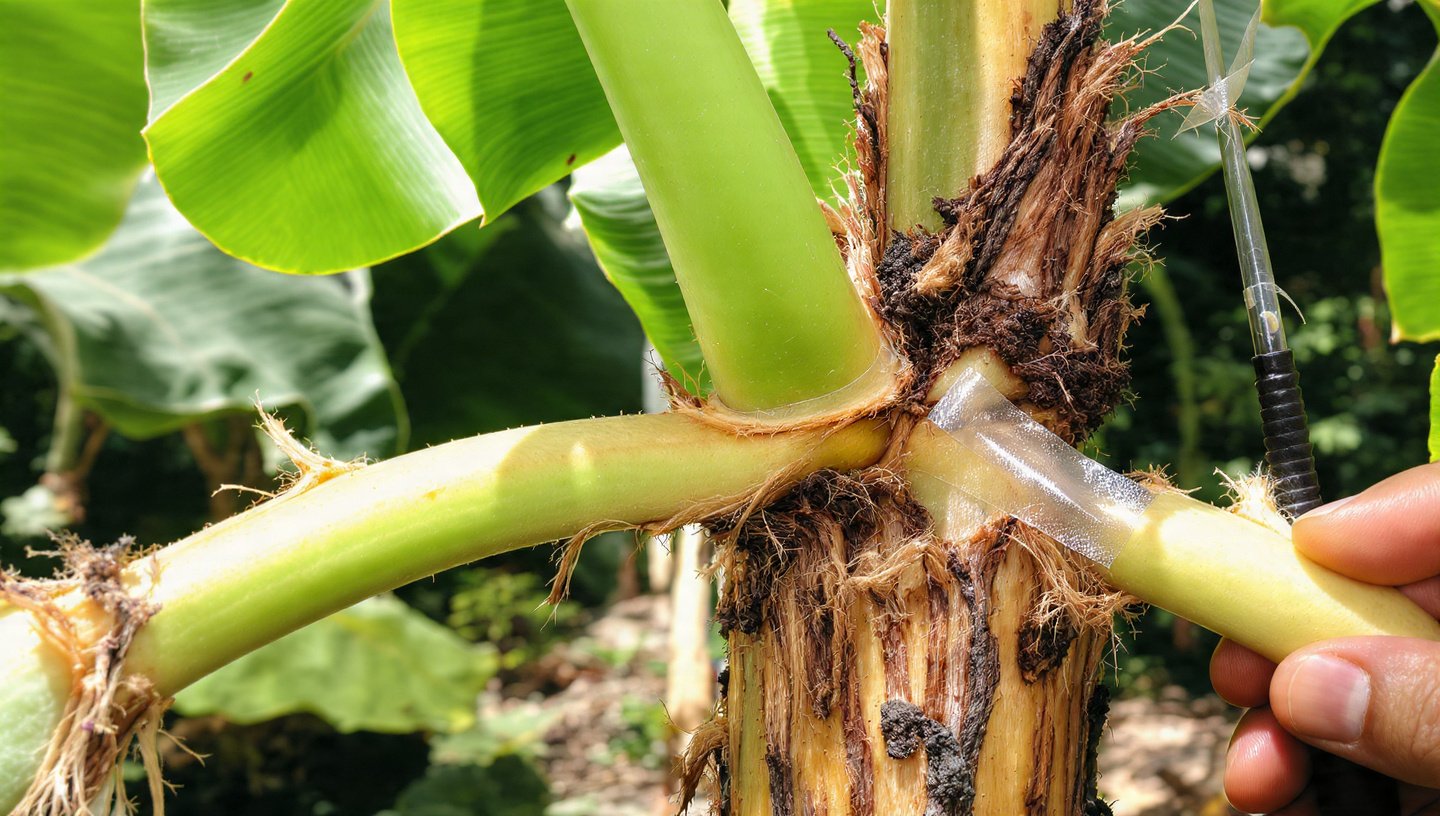
- Align the cambium layers (the green, growth-producing tissue) of both parts for maximum contact.
- Use grafting tape, rubber bands, or cling film to secure the graft, ensuring it is tight but not damaging.
5. Protect and Support
- Cover the grafted area with a plastic bag or shade cloth to retain moisture and reduce stress.
- Keep the plant in a shaded, humid environment for at least two weeks.
- Water regularly but avoid waterlogging.
6. Monitor Growth
- Check the graft for signs of fusion after two to three weeks.
- Once the graft shows healthy new growth, gradually acclimate it to full sunlight.
- Remove tape or covering once the graft is strong and stable.
Tips for Success
- Timing Matters: Graft during the plant’s active growing season, when the rootstock and scion are most likely to fuse successfully.
- Sanitation: Always use clean, sharp tools to reduce the risk of infection.
- Humidity Control: High humidity helps the graft union heal faster, preventing desiccation.
- Choose Compatible Varieties: Rootstock and scion should belong to the same or closely related species for best results.
- Patience: While grafted bananas grow faster, fruiting may still take several months, so care and attention remain essential.
Real-Life Success Stories
Several growers around the world have reported remarkable results using banana grafting:
- In Southeast Asia, small-scale farmers have achieved 20–30% faster fruiting by grafting high-yield varieties onto disease-resistant rootstocks.
- Backyard gardeners in tropical regions have observed larger, more uniform bunches on grafted plants compared to non-grafted counterparts.
- Commercial plantations experimenting with this technique report reduced losses from soil-borne diseases, improving overall productivity.
These examples highlight the practical benefits and transformative potential of this technique.
Grafting vs. Tissue Culture
Tissue culture — or micropropagation — has been widely used in commercial banana production to produce disease-free, uniform plants. While effective, tissue culture requires specialized laboratories and equipment, which may not be feasible for small-scale or home growers.
Grafting offers a hands-on, low-cost alternative that achieves similar benefits:
- Disease control: By selecting a resistant rootstock.
- Faster fruiting: Through vigorous rootstock support.
- Better fruit quality: By controlling the scion variety.
For backyard growers, grafting provides a practical way to maximize banana harvests without relying on industrial-scale infrastructure.
Potential Challenges
Like any horticultural technique, banana grafting has potential pitfalls:
- Graft failure: Improper alignment or poor environmental conditions can prevent the scion from fusing.
- Pest and disease risk: The graft union can be vulnerable if not protected properly.
- Skill requirement: Grafting requires precision and patience, especially for beginners.
Despite these challenges, success rates improve dramatically with practice, proper care, and observation.
Future of Banana Cultivation
As banana demand continues to rise globally, innovative techniques like grafting will become increasingly valuable. Not only does this method improve yields and plant health, but it also offers a sustainable alternative to relying solely on chemical treatments or large-scale monoculture.
Researchers are exploring ways to combine grafting with modern biotechnology, such as disease-resistant rootstocks created through conventional breeding or gene-editing, further enhancing banana productivity and resilience.
For home gardeners and small farmers, grafting represents a low-cost, high-impact strategy to enjoy larger harvests while protecting plants from environmental stresses.
Conclusion
Grafting banana plants is an exciting horticultural breakthrough that combines traditional knowledge with modern agricultural innovation. By uniting vigorous rootstocks with high-quality scions, gardeners and farmers can enjoy:
- Faster growth and earlier fruiting
- Larger, healthier bunches
- Enhanced disease resistance
- Greater control over fruit quality and yield
While it requires careful technique and attention to detail, the rewards are substantial. Whether you are a backyard gardener looking to impress family and friends with lush banana harvests, or a smallholder farmer aiming to maximize productivity, grafting offers a practical and transformative approach.
With practice, patience, and proper care, this simple yet powerful technique can help banana plants reach their full potential — producing bigger, better, and more abundant fruit than ever before.
For anyone passionate about bananas, learning to graft could be the key to unlocking faster growth, bigger harvests, and a thriving, healthy garden. 🍌🌱