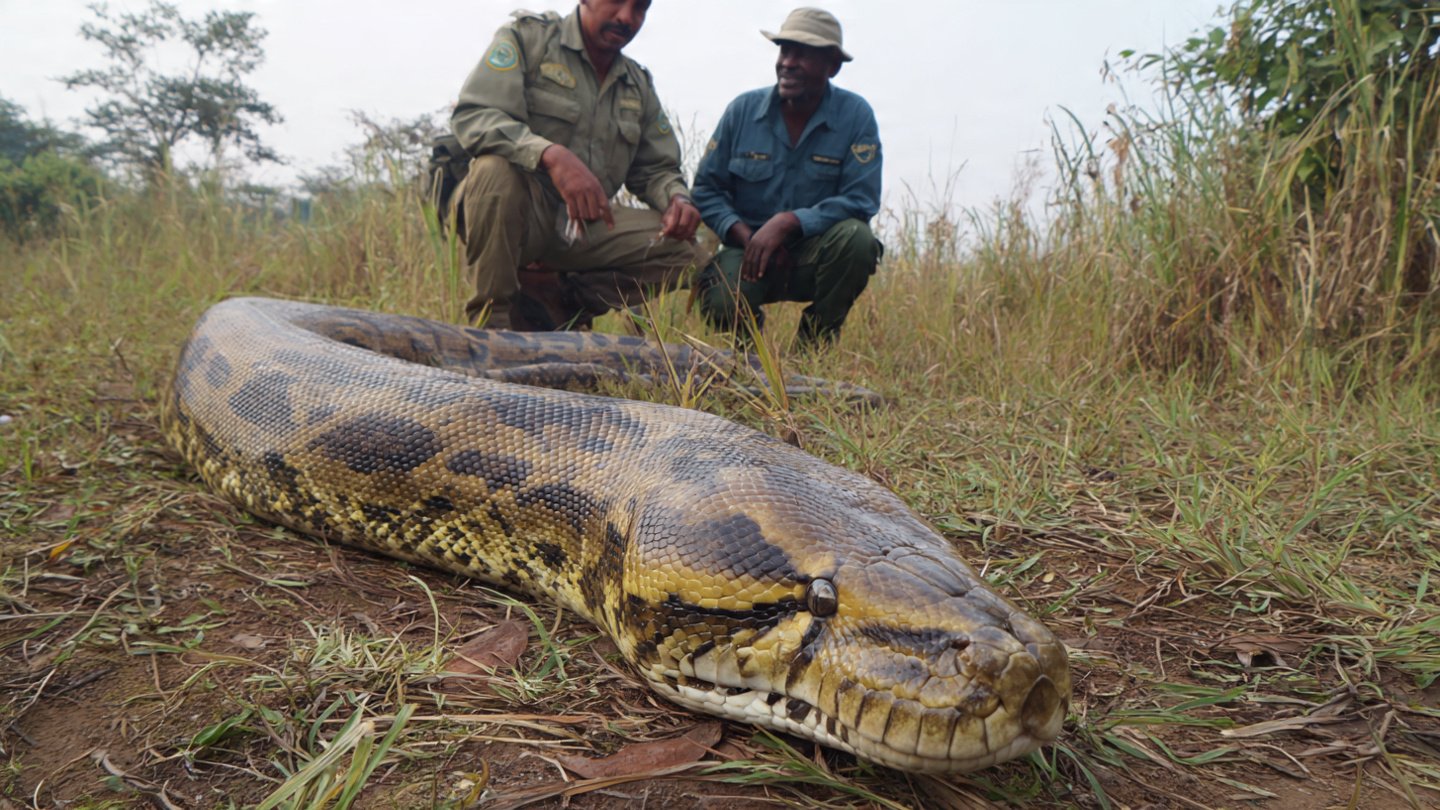
In a remarkable blend of scientific discipline and raw wilderness exploration, a team of herpetologists recently confirmed the existence of an extraordinarily large African rock python during a certified field expedition — a discovery that has riveted the scientific community and reignited curiosity about one of Africa’s most formidable reptiles.
The announcement arrives at a moment when field biology continues to showcase that even well‑studied ecosystems still hold surprises. For decades, scientists have known that African rock pythons (Python sebae) are among the largest snakes on Earth, but this discovery pushes the known boundaries of their potential size and offers a rare glimpse into the lives of these apex predators in nature.
The Discovery — A Night in the African Wetlands
The journey began deep in Africa, where certified herpetologists accompanied local trackers on an expedition under an official biodiversity survey. The team was operating in a remote wetland region of southern Africa when they encountered what would become a landmark moment in reptile research.
According to field reports, the first sign of the snake was not a hiss or sudden movement but a strange calm in the environment — an eerie silence that fell among the grass and reeds. As the team moved closer, what seemed like a fallen log or a dark shadow turned out to be something living, powerful, and massive.
In the dim light of dawn, a broad, patterned form revealed itself. Coiled and still, it was unlike anything the researchers had expected. After weeks of tracking signs like drag marks near riverbanks and drone footage hinting at large, thick forms, they were finally staring at the source — a python of unprecedented proportions.
Measuring a Giant — Science Meets Protocol
Measuring a snake of such size in the field is far from a casual task. In the world of herpetology, rigorous and standardized documentation is essential to ensure that extraordinary claims are backed by indisputable evidence. This snake was measured under certified protocols involving multiple trained observers, calibrated tools, and detailed record‑keeping that included photographs, GPS data, and field notes.
The results were stunning:
- Length: Just over 6.5–7 meters (about 21–23 feet)
- Girth: Body thickness greater than an adult human thigh
- Weight: Estimated well above 100 kilograms (220+ pounds)
- Species: African rock python (Python sebae)
These measurements place this python well above the average size for its species and among the largest scientifically documented individuals ever observed in the wild. Unlike folklore or unverified sightings, these figures were not estimated or guessed — they were recorded using accepted scientific practices.
Why This Matters for Science
Size records in wildlife are often treated with skepticism, especially when based on hearsay or casual photos. That’s why this confirmation is significant: it wasn’t just a sensational headline — it was the result of a certified field expedition with strict scientific protocol.
Accurate measurement matters because:
- It helps refine our understanding of the biological limits of species.
- It provides insight into growth patterns, habitat suitability, and longevity.
- It validates local ecological observations within a scientific framework.
- It bolsters conservation research with documented case studies.
African rock pythons are already known to reach substantial sizes, with typical adults stretching between 4 and 5 meters (13–16 feet) in length. But individuals beyond 6 meters are rare, and those approaching 7 meters are exceptional. This discovery helps show that under certain conditions — ample food, suitable habitat, and enough time to grow — these reptiles can far exceed what statistical averages suggest.
Beyond Size — The Story of a Survivor
The biological profile of this python offers clues about its life. The animal’s thick, muscular body and well‑defined scales suggest decades of successful survival in a challenging landscape. Its pattern — olive‑brown scales with dark blotches — provided natural camouflage among reeds and seasonal floodplain vegetation, highlighting how these snakes blend into their environment both visually and ecologically.
The absence of significant scars or injuries on the snake’s body indicates that it likely navigated predation pressures and human encounters without sustaining major trauma — a testament to its adaptability and resilience. Its exceptional size also suggests a healthy prey base in the region, meaning the local ecosystem is functioning well enough to support large predators at the top of the food chain.
What’s equally remarkable is how the python reacted during the scientific handling process. Despite its power, the snake exhibited controlled defensive behavior rather than aggression — a reminder that even apex predators act according to instinct rather than defiance. After careful biometric data collection, the team released it back into its habitat, where it slipped back into the shadows with astonishing grace.
Challenges and Ethics in Field Herpetology
Documenting large wild animals like this python is challenging. A certified field expedition must balance ethical animal handling with accurate data collection. Stress minimization, proper restraining techniques, and rapid release are essential to ensure that the animal is unharmed. This expedition followed international welfare guidelines and protocols by experienced specialists.
Moreover, involving local guides and wildlife scouts was crucial. Indigenous knowledge played a key role in leading scientists to the areas where sightings were reported — examples of how traditional ecological insight and modern science can complement each other.
Implications for Conservation
This discovery arrives at a time when many large reptiles face increasing pressures from habitat loss, human conflict, and environmental change. African rock pythons, while not presently endangered, often find themselves targeted due to fear or misunderstanding. Verified sightings of individuals this size underscore the importance of conserving their habitats and educating surrounding communities about coexisting with wildlife.
By documenting exceptional specimens scientifically, researchers not only deepen our comprehension of wildlife biology but also highlight the need to protect the rich biodiversity that makes such discoveries possible. Every apex predator is a sign of ecological health — and the existence of giants like this python suggests that, at least in some pockets of the world, nature still thrives.
Putting Legends to Test
Stories of giant snakes have long been woven into folklore across African cultures — tales of serpents that stretch between termite mounds or swallow livestock whole. Field biologists often hear such stories, but without proper documentation, they remain anecdote. This expedition turned one such tale into a recorded scientific event.
While this python is not the longest snake ever documented in global terms — with other species, such as reticulated pythons in Southeast Asia, measured over 7 meters and even approaching world records — it stands as one of the largest individuals verified under certified field conditions.
What This Means for Future Research
The confirmed discovery opens new avenues for future studies:
- Population dynamics: Researchers can investigate whether other large individuals exist nearby.
- Growth patterns: What environmental conditions allow such exceptional growth?
- Genetic studies: Are there genetic traits that favor larger size within local python populations?
- Human‑wildlife coexistence: How can communities and large predators share space with minimal conflict?
Each of these questions pushes the envelope of reptile science and deepens our understanding of how animals adapt to changing ecosystems.
Final Thoughts
The confirmation of an exceptionally large African python by herpetologists during a certified field expedition is more than just an attention‑grabbing headline — it’s a reminder of the wonders that still exist in the natural world. With careful science, respect for local knowledge, and rigorous documentation, researchers continue to uncover the extraordinary.
This giant snake — measured, respected, and released — represents not just a single animal, but the enduring complexity and resilience of life on Earth. In an age where many species are declining, the existence of such a specimen gives hope that untamed corners of the world remain capable of sustaining true biological marvels.